
Character as the Measure of Worth, Discipline and Virtue as Instruments of Growth
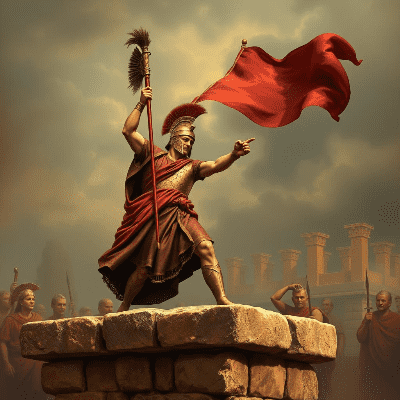
In ancient Rome there existed a principle so self-evident that it required no explanation, and so solid that it sustained centuries of history: the worth of a person was not measured by what they possessed, nor by what they promised, but by what they were capable of bearing. This principle took shape in what the Romans called mos maiorum, the custom of the ancestors: not a written law, not an abstract moral code, but a set of inner criteria through which an individual was recognized as reliable, worthy of responsibility, capable of holding their place in the world.
At the center of this horizon stood honor. Not sentimental honor, nor honor put on display, but a concrete, verifiable quality that revealed itself under pressure. To be a person of honor meant to uphold one’s role, not to fall short of one’s word, to hold one’s position even when retreat would have been easier. In a civilization founded on personal responsibility, honor was not an ethical ornament, but a load-bearing structure: without it, no shared endeavor, no lasting trust, no continuity was possible.
For this reason, the Romans never separated personal worth from character. Character was not a psychological disposition, but a form acquired over time, the result of repeated choices, of exercised self-control, of internalized discipline. A person did not “have” character; they built it, and made it visible through coherence between what they said and what they did. A given word was not an abstract promise, but a commitment that exposed the one who made it; keeping it meant assigning weight to oneself, betraying it meant beginning to consider oneself, inwardly, unreliable.
Here a distinction emerges that the modern world tends to lose: that between real resilience and emotional resilience. Real resilience does not consist in talking about one’s difficulties, nor in seeking understanding or relief, but in remaining functional when circumstances become adverse. It is the ability not to fragment inwardly, not to lose clarity, not to turn pressure into complaint. The Romans did not deny suffering; they simply did not display it as an identity. A person could fall, but they were not meant to become small.
Discipline, in this framework, was not a form of punishment nor a renunciation of freedom. On the contrary, it was the very condition of freedom. Without discipline a person is not free: they are reactive, at the mercy of impulses, circumstances, and inner fluctuations. Discipline gave form to energy, made it directional, reliable, capable of sustaining a course over time. It did not serve to repress the body or the will, but to render them instruments obedient to a higher choice. Someone incapable of governing themselves could not hope to carry any task beyond the immediate.
From this discipline arose gravitas: that inner weight which makes a person stable, not easily swayed, not in need of constant validation. Gravitas had nothing gloomy or rigid about it; it was the natural consequence of a coherent life. Alongside it stood maiestas, not as ostentatious superiority, but as natural height, spontaneous distance, an authority that does not beg for approval. In a society founded on roles, the person who voluntarily lowered themselves lost not only prestige, but credibility.
Courage, in this world, did not coincide with the spectacular gesture or the sudden break. There existed a rarer and less celebrated courage: the courage to remain. To remain faithful to a commitment when no one is watching, to remain coherent when it would be more convenient to change course, to remain intact when the surrounding environment rewards opportunism. This kind of courage produces no epic tales, but it builds solidity. And it is precisely this solidity that allows one, in critical moments, not to collapse.
All of this found synthesis in a central concept of Roman culture: virtus. Not virtue in the modern moral sense, but a force at once ethical and operative, the capacity to distinguish oneself from insignificance. Virtus did not promise success, well-being, or immediate recognition. It guaranteed something more essential: the possibility of standing upright before oneself. In a world well acquainted with risk, loss, and trial, this was a decisive conquest.
The ancients did not idealize the human being; they understood its inner laws. They had grasped that without honor trust dissolves, without discipline energy disperses, without character personal worth becomes unstable. Similar principles have emerged in different civilizations, at different times, because they do not belong to a particular culture: they belong to the structure of the human being when put to the test.
The modern world, in its attempt to protect the individual, has often ended up weakening them to the point of making them insubstantial. It has replaced character with intention, discipline with expression, honor with self-perception. The result is evident: much sensitivity, little endurance; many words, few commitments kept; much proclaimed freedom, little capacity to bear the weight of one’s own choices.
Recovering these principles does not mean going backwards, nor imitating the past. It means remembering that there are inner laws that cannot be bypassed without paying a price. The ancients, Mediterranean or otherwise, were not wiser because they were better, but because they were more exposed. And what they discovered has never truly disappeared: it simply awaits recognition by those willing to become someone capable of bearing their own destiny, without seeking shortcuts.
by Brunus


