
Dionysus, the god of creative chaos and of experience beyond limits
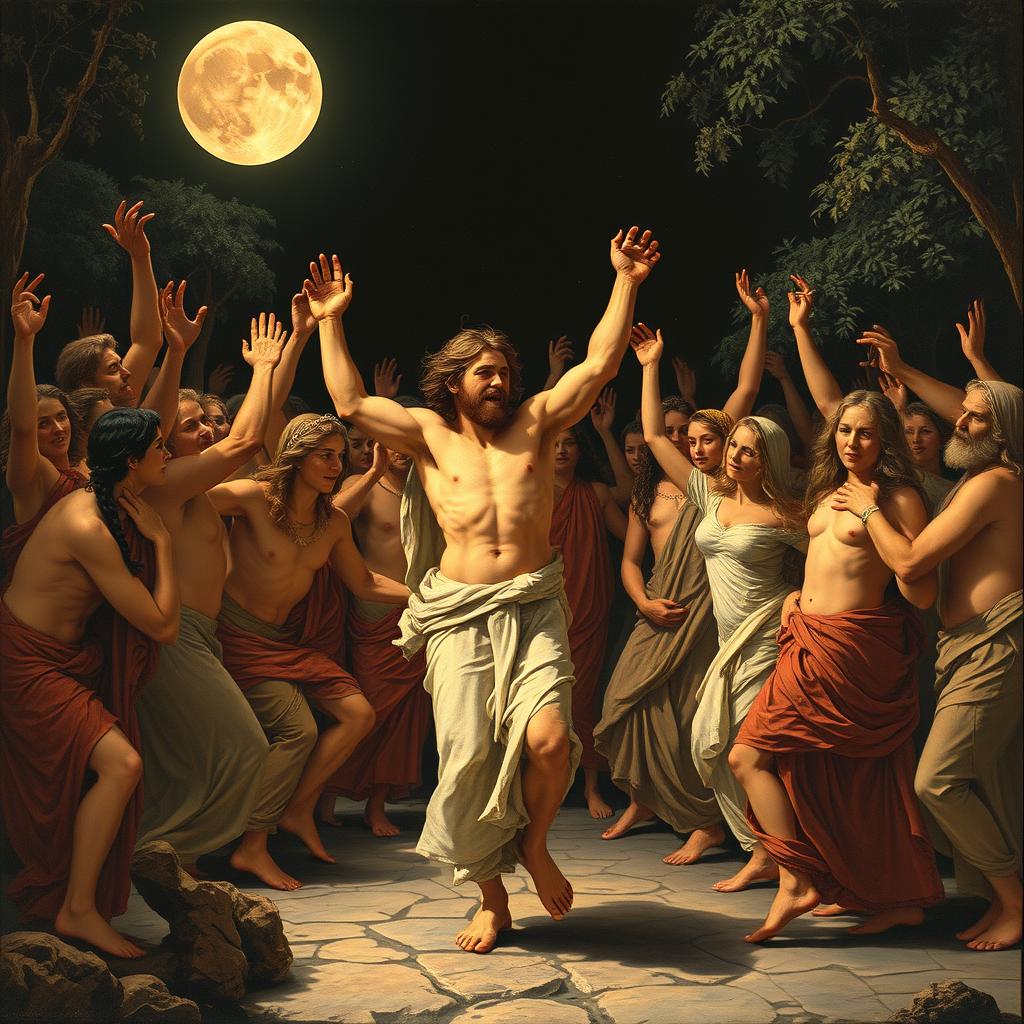
From chaos to dance: the Dionysian path to freedom and rebirth
Among all the divinities of the ancient world, Dionysus is perhaps the hardest to define. He is the god of wine, yes, but also of ecstasy, rebirth, disorder, and freedom. He is the god of experience that transcends every boundary. To speak of him in a single article is impossible; we can only approach him, choosing one thread to follow. Here, it will be his most fascinating power — that of creative chaos, capable of dissolving forms to reveal what lives beneath them.
In Greek thought, Dionysus embodies the principle opposed to Apollonian order. If Apollo builds, measures, and separates, Dionysus unites, confuses, and melts. His chaos is not destructive but sacred — an energy that breaks limits to restore life to its totality. Whoever tries to live only within reason and law, like Pentheus in Euripides’ Bacchae, is destroyed by this force; whoever dares to embrace the irrational, the flow of life, finds union with the divine.
Dionysus unmasks. In his festivals, men and women wore masks only to be freed from their social ones: the ritual mask served to remove the inner one. The Dionysian ecstasy is the suspension of the ego, the loss of roles, the return to that deep part of oneself that civilization represses. His “madness” is not pathology but liberation — direct contact with life itself, without screens, without judgment.
His myth teaches that one must die to oneself in order to be reborn whole. Torn apart by the Titans and reassembled, Dionysus lives again the archetype of transformation: every human being carries within the same destiny. What we call crisis or chaos is often the preparation for a new unity — a process of anamnesis, a deep remembering of who we really are. The fragments of our identity, like those of the god, must be recognized and rejoined to recover the sense of wholeness.
Dionysus is also a bridge between realms: between life and death, visible and invisible, human and divine. He descends into darkness and rises again bringing the light of consciousness, as Orpheus and later Christ will do. The ecstatic experience he offers is not escape but revelation — the discovery of the immanent divine, not in a distant heaven but in every form of life, in every breath, in every true joy.
According to Orphic tradition, Dionysus is torn apart by the Titans because divinity must break itself to become the world. It is an extraordinary image of creation as sacrifice: infinite life shattering into countless finite lives. From that fracture humanity is born — part Titanic, part Dionysian, matter and spirit together. Our task is to recompose what has been divided: to rediscover, in the fragment, the memory of unity.
Perhaps this is what we lack today: the ability to surrender to chaos without being destroyed by it. We live in a world obsessed with control, performance, and precision; yet without Dionysus, the soul withers. Sometimes we must let life shake us, let certainties melt, let a bit of sacred madness open a breach in the wall of habit. Only then can something new be born. As Nietzsche wrote in Thus Spoke Zarathustra, “One must still have chaos in oneself to give birth to a dancing star.”
To find Dionysus today does not mean drunkenness or loss of reason: it means embracing the energy of transformation. It means remembering that within confusion may lie rebirth, and that the divine reveals itself not in perfection but in motion, passion, and mystery.
Whoever dares to pass through their own chaos will find, at its heart, not destruction — but dance.
by Brunus


