
Dancing on the Edge of Chaos: When Evolution Is Born from Disorder
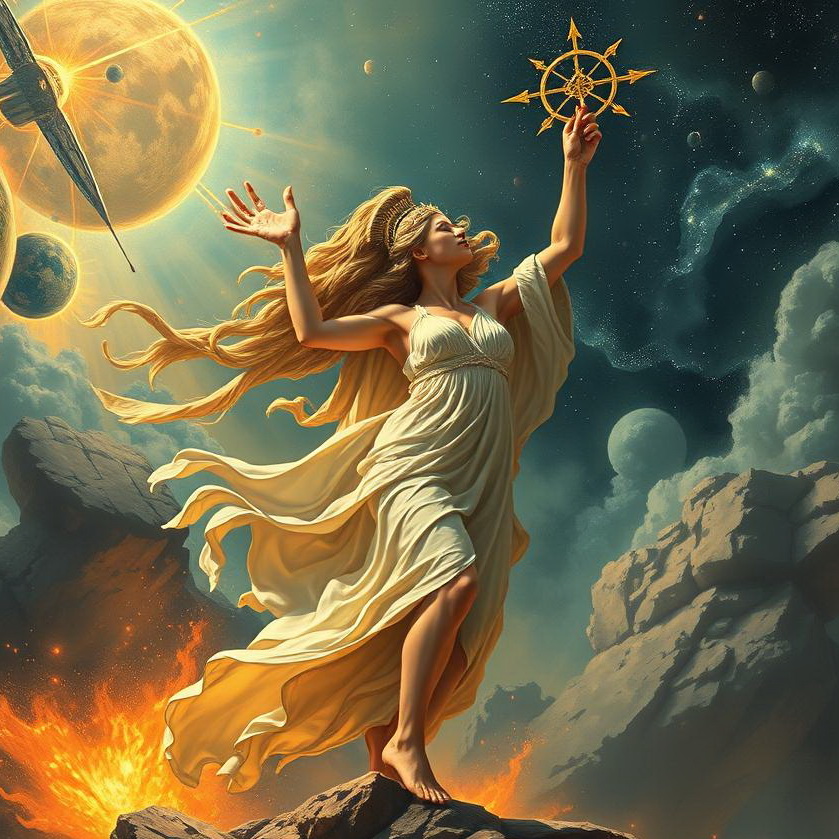
There is a point where perfect order breaks, and disorder has not yet won.
It’s a thin, trembling line where the universe seems uncertain whether to collapse or create — and right there, on the edge of chaos, life, art, intuition, and evolution are born.
“Polemos is the father of all things, and king of all. He renders some gods, others men; he makes some slaves, others free.” – Heraclitus
The ancients knew this. Heraclitus called Polemos (Πόλεμος, the demon of war) the father of all things: not destruction, but creative tension.
Today, science rediscovers it under the name autopoiesis: every living system strives to preserve itself, but only through continuous exchange with what threatens it.
Too much stability leads to death, too much instability to collapse. Growth happens in between — in that unstable zone where form wavers, but does not fall.
That’s why every system — an organism, a company, a relationship, even an idea — reacts to visionaries like a body to a virus. Genius disturbs: it questions the rules, forces change.
But without that vital disturbance, the structure decays into its own bureaucracy.
The same happens to us: when everything runs smoothly, we stop evolving; when chaos knocks, we awaken.
Creativity, after all, often arises from mistakes and coincidences: serendipity is the elegant name for chaos cooperating with us: you look for a needle in a haystack and find the farmer’s daughter, someone said — and in that unexpected encounter, life changes course. The Muses, whom the ancients invoked before every undertaking, are nothing but this: the readiness to listen to disorder, to be inspired by what we cannot control.
Each time we accept uncertainty, a deeper part of us answers — our daimon, our genius, who knows the way even when the mind is confused.
“You must still have chaos within you to give birth to a dancing star.” – (Nietzsche, Thus Spoke Zarathustra)
Today we need this more than ever. We live in organizations and societies that reward predictability, procedure, obedience to the rule, but a system too ordered becomes sterile.
The leader, the parent, the teacher, the creator who truly wants to help others grow must learn to dance on the edge of chaos: to leave space for the unexpected, to welcome disturbing ideas, to tolerate the risk of being wrong.
Every small act of intelligent disorder opens an evolutionary window.
On a personal level, the rule is the same: when life seems to “fall apart,” it’s often just the old form that can no longer hold. We need the courage to stay in chaos long enough for a new order to emerge — not imposed, but born from within.
That’s when the star begins to dance.
The Mediterranean secret, in the end, is simple: don’t fight disorder — dialogue with it.
Learn to sense when the form must dissolve and when it must be protected. Like the sea, alternating calm and storm, never ceasing to be sea.
Perhaps evolution is nothing more than this: an endless dance between the order that protects us and the chaos that renews us.
And in that dance, if you listen carefully, you can still hear the voice of the Muses —
or, if you prefer, of your inner daimon — whispering:
“Do not fear disorder. It is only life changing shape.”
by Brunus


