
Managing complexity: when logistics beats heroism
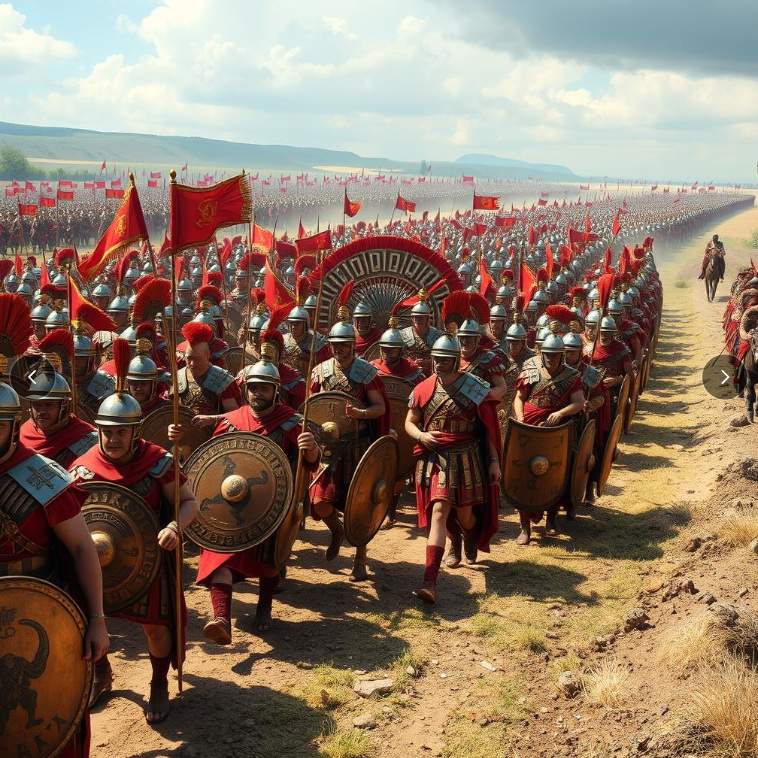
Can you visualize 50,000 men marching?
Not in a Hollywood movie, with epic music in the background, a general on a white horse and a legionary shouting “For Rome!”. I mean really visualize it. Fifty thousand human beings walking for weeks or months, crossing mountains, rivers, forests and hostile territories. On foot. Without radios, GPS, smartphones, emails, WhatsApp or the possibility of pressing a button and magically having supplies arrive.
Now think about it a little more carefully.
Those fifty thousand men need to eat every single day. They need water. They need shoes that don’t fall apart after three days of marching. They need fires, camps, medical care, functioning weapons and a way to cross rivers. They need orders, discipline and coordination. And — a detail that somehow never appears in historical blockbusters — they also need latrines.
Yes, because when you have thousands of men camping together, the question of where they relieve themselves very quickly stops being a minor issue. Contaminate a water source and, instead of fighting the enemy, you suddenly find yourself losing men to dysentery, infections and disease. It is no coincidence that, for most of human history, armies lost more soldiers to epidemics and logistical failures than to actual combat.
And this is where things become interesting. Rome did not conquer the Mediterranean through heroism alone. It conquered it through the ability to manage complexity.
The invisible machine behind the empire
Modern culture has trained us to imagine history as a sequence of heroic acts, charismatic leaders and glorious battles. But empires are not held together by motivational speeches. They are held together by organization.
The Romans understood this perfectly.
Every evening a legion built a castrum, a fortified camp organized according to almost obsessively standardized procedures. It did not matter whether they were in Gaul, Britannia, Dacia or the desert: the camp had to follow the same structure, with internal roads, defensive systems, operational areas, storage zones, controlled access points and, naturally, systems for managing water and waste.
Think about this for a moment. Without computers, spreadsheets or project management software, they managed to coordinate tens of thousands of men across enormous territories while maintaining a level of operational efficiency that many modern companies would envy.
And the Roman legionary was not merely a warrior. He was also a builder, engineer, laborer and transporter. There is a reason why the soldiers of Gaius Marius were nicknamed “Marius’ mules”: they carried much of their own equipment, including weapons, tools, food supplies and even the stakes needed to build the camp itself.
Behind the myth of Roman heroism stood an enormous organizational machine.
When communication is slow, the system must be stronger
There is another aspect of Roman logistics that has always fascinated me.
Today we are used to instant communication. A manager can organize an emergency Zoom call with people spread across three continents. A modern general can receive satellite images in real time.
The Romans had none of this.
If a legion was hundreds of miles away from Rome and things started going badly, there was no emergency group chat. No urgent video call with the Senate. No live updates. And if reinforcements arrived one day too late… well, that was the end of the story.
This forced Rome to develop something many modern organizations struggle to build: true systemic resilience.
When communication is slow, the system itself must be better designed. Procedures must be clear. Responsibilities must be defined. Officers must know how to act without waiting for constant instructions. Discipline was not only meant to impress the enemy; it existed to make the behavior of the system predictable.
And this is where Roman history stops being archaeology and becomes management.
The lesson for the modern world
Today many organizations constantly talk about leadership, vision, mindset, innovation and motivation. All important concepts, of course. But very often they neglect the rest.
And yet companies collapse far more easily because of confusion, inefficient processes, chaotic communication, unsuitable tools, exhausted people and lack of coordination than because of a lack of enthusiasm.
Hollywood shows us the general on horseback.
Rome, on the other hand, probably understood that the fate of an empire also depended on someone making sure the bread arrived on time, the roads remained usable and the latrines were far enough away from the water supply.
At first glance, this may sound far less romantic.
But if you think about it carefully, it may actually be far more impressive than yet another slow-motion battle scene with dramatic music playing in the background.
by Brunus


