
Chrematistics:
the ancient art of making money!
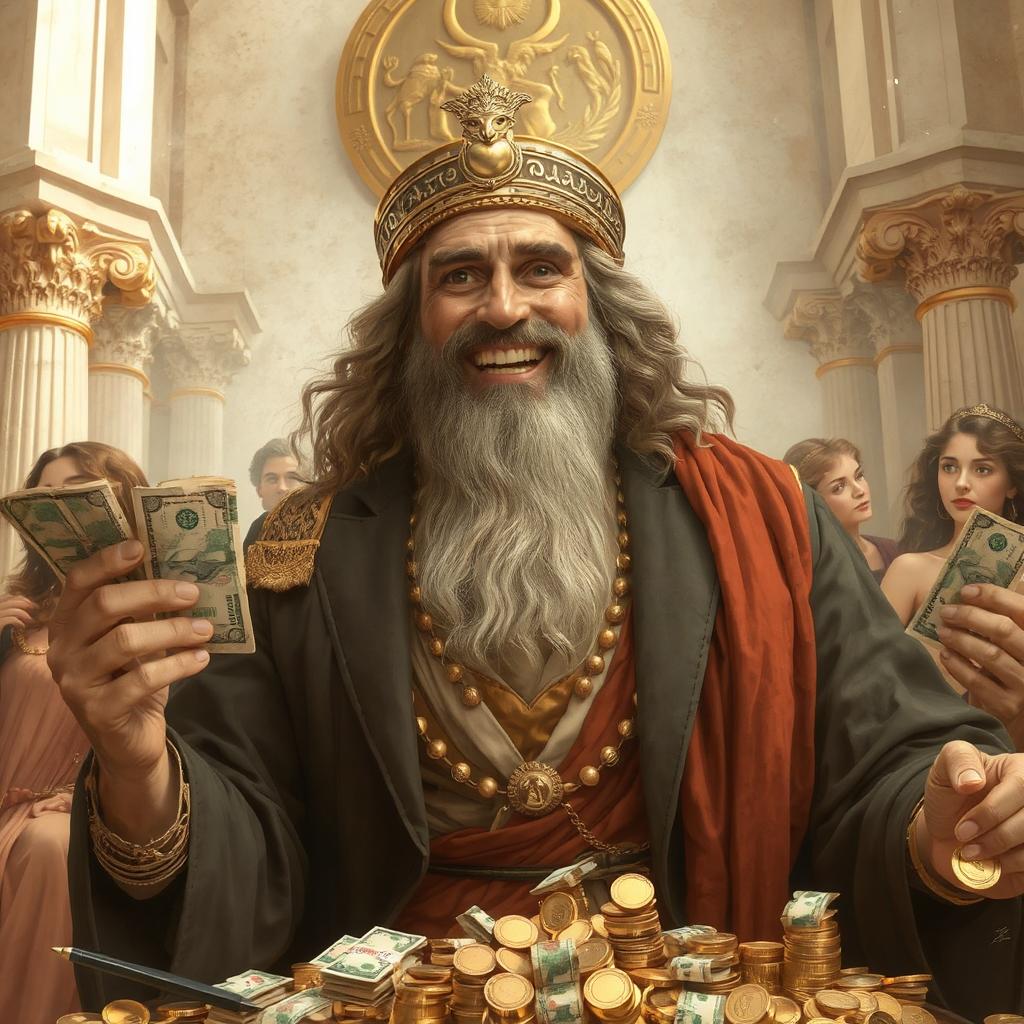
Money. The word itself sparks curiosity, ambition, maybe even a bit of unease. We chase it, spend it, save it, worry about it—yet how many of us truly understand it?
If you think the modern world is obsessed with wealth, you should take a closer look at the Mediterranean of antiquity. The people who lived along its shores—Greeks, Phoenicians, Romans, Egyptians—were the financial pioneers of their time. They didn’t just work for money; they mastered it, bent it to their will, used it to build empires, finance wars, create art, and shape civilizations.
And yet, even back then, there was debate. Was the pursuit of wealth an art or a corruption of the soul? Was money a tool or a trap? No one wrestled with this question more than Aristotle.
When money was born
Before the world had coins, trade was a messy business. Imagine trying to buy a new tunic when all you have is a sack of olives. The shopkeeper doesn’t need olives, but maybe she’d take some bronze tools—so now you have to find a blacksmith willing to trade. The system was clunky, inefficient, and frustrating.
And then, somewhere around 600 BCE, everything changed. The Lydians, a people from what is now western Turkey, under the rule of King Alyattes, introduced the first real coins—small, stamped discs of electrum, a natural gold-silver alloy. For the first time, wealth had a universal language. A merchant in Athens, a sailor in Carthage, and a trader in Egypt could all agree on the value of a coin. Commerce flourished.
But money wasn’t just about trade; it was about power. Rulers controlled it, philosophers questioned it, and those who understood it thrived.
Aristotle’s suspicion: when does money become a curse?
Among those who looked at this new world of wealth with skepticism was Aristotle. He saw two very different approaches to money.
One, which he called oikonomia (οἰκονομία), was the art of managing resources wisely—using wealth to sustain a household, support a city, or create something valuable. This, he thought, was noble.
The other, which he called chrematistics (χρηματιστική), was something else entirely. This was the obsessive pursuit of wealth for its own sake, an endless cycle of accumulation, where money was no longer a tool but the ultimate goal. To Aristotle, this was dangerous, even unnatural. Money should serve life, not the other way around.
But here’s where things get interesting. While Aristotle warned against the excesses of chrematistics, the great traders of the Mediterranean were already proving that wealth, when handled with skill and strategy, could build legacies rather than destroy them.
The ancient Mediterranean’s money-making wisdom
To understand how the ancients approached wealth, you have to look beyond philosophy and into the bustling marketplaces of the Mediterranean—places where merchants from different lands haggled in a dozen languages, where silver and spices changed hands, where ships loaded with Egyptian linen and Phoenician glass set sail toward distant ports.
Money, in this world, wasn’t something to fear. It was something to be understood, controlled, and used.
Take the Phoenicians, for example. They didn’t waste time toiling the land when they could master the art of trade. They were among the first to realize that money moves faster when you don’t cling to it—buy low, sell high, reinvest. While other civilizations relied on labor, they relied on movement.
Or consider the importance of reputation. In the ancient world, trust wasn’t just a moral virtue; it was currency. A merchant known for fair dealings would always have customers, while a dishonest trader, no matter how much gold he hoarded, would eventually find his business collapsing. Even the Romans had a term for it: fides publica, public trust. Without it, you had nothing.
Then there was the idea of diversification, something the ancient traders understood instinctively. The Phoenicians didn’t bet everything on one commodity. They dealt in textiles, timber, glass, metals—ensuring that if one market failed, another would thrive. In modern terms, they didn’t keep all their wealth in a single stock; they spread the risk, allowing them to weather economic storms.
And perhaps most importantly, the Mediterranean civilizations understood that wealth needed a purpose. For all the criticisms Aristotle had of chrematistics, the truth was that the greatest cities of antiquity—Athens, Rome, Carthage—were built on the strategic use of money. It wasn’t just hoarded; it was reinvested into roads, ships, temples, and theaters. Money wasn’t the enemy. The real danger was forgetting why you wanted it in the first place.
Mastering the ancient art of wealth
So what can we take from all this? That money, when approached wisely, is neither good nor evil—it is power. But power needs direction.
The ancient Mediterranean traders understood what many today forget: making money is not about mindless accumulation. It is about flow, exchange, movement. It is about reputation, adaptability, and knowing when to spend as well as when to save.
Perhaps Aristotle was wrong about chrematistics. Or perhaps, had he walked through the harbors of Tyre or the markets of Corinth, watching gold coins change hands with a knowing smile, he would have seen that wealth, in the right hands, is not a curse at all—but a force for building something greater.


