Aesop and the Critical Success Factor
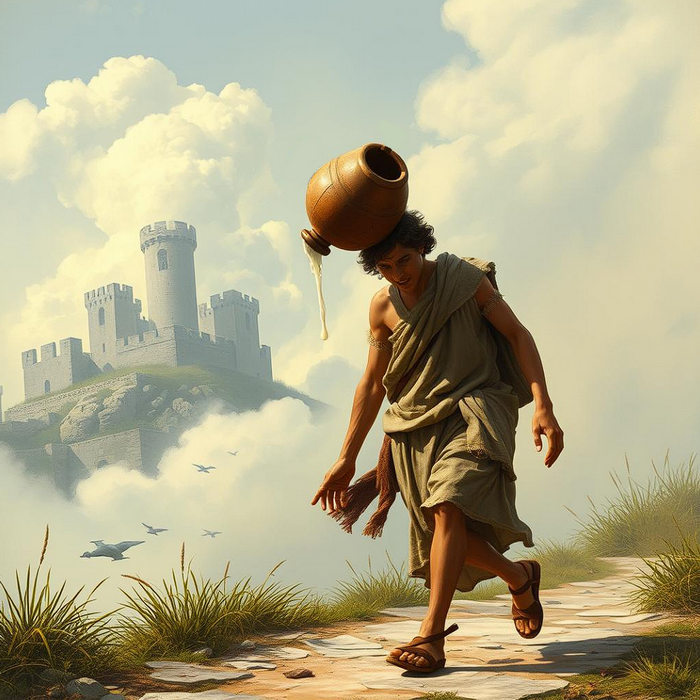
The castle we build in our minds
More than twenty-five centuries ago, Aesop told a story that probably contains more practical wisdom than many modern management books.
A man is walking to the market carrying a container full of milk on his head. As often happens when our hands are busy but our mind is free, his thoughts begin to run much faster than his feet. He will sell the milk, buy some eggs, hatch the eggs into chickens, sell the chickens, buy a pig, then a cow, then a flock of sheep. Before long he owns a large house, servants, wealth and social status. Finally, he imagines choosing the most beautiful woman in the village as his wife and, should she ever dare to contradict him, he pictures himself shaking his head in disapproval.
As he imagines that scene, he unconsciously performs the gesture.
The container falls.
The milk spills.
And with it disappear the sheep, the house, the servants and every bit of wealth that existed only in his imagination.
The usual moral of the story is that we should not build castles in the air. That is certainly true, but perhaps it misses Aesop’s deeper point. He is not telling us to stop dreaming. He is warning us not to overlook the one small detail on which everything else depends.
The one factor that changes everything
Imagine that you come up with a brilliant idea: a new bottled water brand that will revolutionize the market. You develop an innovative bottling process, design impressive production facilities, register the trademark, commission a memorable logo, create an international distribution network, negotiate with supermarket chains, hire consultants, refine the marketing strategy and, naturally, begin planning how you will spend the fortune your business is about to generate. Then someone asks a painfully simple question.
“Is the water actually drinkable?”
It isn’t.
At that point, the logo, the marketing strategy, the distribution network and the production facilities suddenly become irrelevant. You have designed a perfect business around the one thing that could never work.
In management, this is known as a Critical Success Factor. Every project, regardless of how sophisticated it appears, ultimately depends on one or two essential conditions. If those conditions are missing, everything built upon them loses its value.
Dreams need reality
There is nothing wrong with dreaming. On the contrary, every scientific breakthrough, every great company, every artistic masterpiece and every major innovation began as something that existed only in someone’s imagination. Human progress depends on our ability to envision a future that does not yet exist.
The problem begins when we quietly stop distinguishing between the dream and reality: imagination should inspire creativity; it should never replace verification.
That is precisely what happens in Aesop’s story. The man does not lose the milk because he has an ambitious vision. He loses it because, in his mind, the vision has already become reality.
The success stories we never hear
We all admire extraordinary entrepreneurs. The stories of Bezos, Musk, Jobs and many others are often presented as proof that we should believe in our dreams, ignore criticism and never give up. There is truth in those stories, but they are only part of the picture.
For every entrepreneur who becomes a global icon, there are countless others who were equally intelligent, equally committed and equally convinced of their ideas, yet failed because one crucial assumption turned out to be wrong. We also tend to forget the investors, the years of financial losses, the favourable circumstances and, sometimes, a considerable amount of good fortune that helped transform a promising idea into a global success.
This is not an argument against ambition, it is simply a reminder that reality does not reward enthusiasm alone.
When artificial intelligence agrees with us
There is another aspect that deserves attention: in the past, we would present our ideas to friends or colleagues, risking criticism that could expose weaknesses in our plans. Today, more and more people present those same ideas to artificial intelligence. AI can generate business plans, financial projections, marketing strategies and operational models with remarkable speed and consistency.
That is exactly why it is so powerful; it is also why it can become dangerous:
artificial intelligence works from the assumptions we provide. If those assumptions are flawed, AI will simply produce a beautifully structured plan built upon the same flawed foundation. Logical consistency does not automatically prove that the starting point is correct.
A magnificent castle built on unstable ground is still unstable.
Reality is remarkably stubborn
History is full of brilliant, educated and determined people who devoted their lives to impossible goals. Thousands of alchemists tried to turn lead into gold. Even today, countless people continue searching for the perfect system to beat roulette or consistently win the lottery. There is even a museum dedicated to perpetual motion machines—and every single one of them is permanently still.
These people were not lacking intelligence.
They were not lacking perseverance.
They were not lacking motivation.
They simply built years of work upon assumptions that reality refused to support.
Reality has one particularly inconvenient characteristic: it continues to operate according to its own rules, regardless of how passionately we wish those rules were different.
Aesop’s real lesson
There is one final detail in Aesop’s story that is easy to overlook.
Nothing happens while the man is merely dreaming. The real problem begins when those dreams start influencing his actions. The same thing happens whenever we spend money we have not yet earned, make decisions based on results that exist only in our imagination or build the fifth floor of a house before checking whether the foundations can actually support it.
Dreaming remains one of our greatest human abilities, and we should never lose it.
But dreams deserve solid foundations; otherwise, we may spend years perfecting every detail of a project that could never succeed simply because we forgot to verify the one condition that mattered most.
Perhaps that is the real lesson Aesop wanted to teach us. Dream as boldly as you wish—but before building the castle, make sure the ground beneath it is real.
by Bruno


