
Odysseus and Mētis: intelligence beyond the algorithm
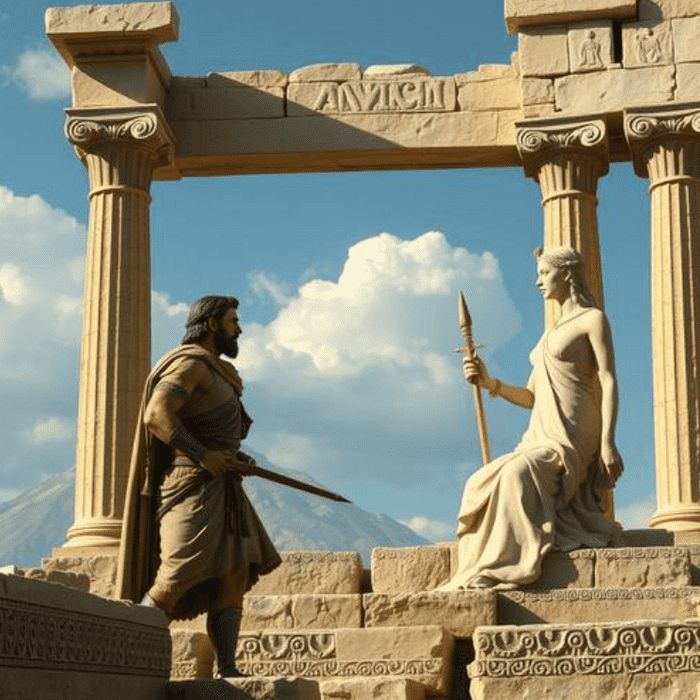
What should you do when you realise you cannot win?
When we understand that we cannot win a game, our most common reaction is to try to play it better: we study the rules more carefully, increase our effort, refine our technique and repeat with even greater determination the moves that, at least in theory, should lead us to the desired result.
Odysseus does something different.
He does not necessarily try to become stronger than his opponent, because he knows that in many situations he would have neither the time nor the means to do so; instead, he tries to understand what game has been imposed upon him, who established its rules and whether there is a way to transform the contest before even attempting to win it.
He is not the strongest of the Greek heroes, he is not invulnerable and he frequently lacks the resources required to confront what he encounters. Achilles wins because, on the battlefield, he is simply superior to everyone else; Odysseus survives because he understands that it is not always wise to accept the ground chosen by the opponent and that, when a game cannot be won, it may still be possible to change it.
This is where mētis (μῆτις) enters the scene: the practical, mobile and oblique intelligence capable of inventing a way out while the problem itself is still taking shape. It is not the opposite of reason, nor is it mere cunning elevated into a philosophy; it is the kind of intelligence we need when the rules still exist, but are no longer sufficient.
Before playing, understand the game
Every game has a field, a number of players, an objective, a set of rules and a criterion that determines who has won. This is true of chess and football, but also of a negotiation, a career, a conflict or a crisis; the difference is that, in real life, the declared rules do not always coincide with the rules that actually operate, the real objective may be very different from the official one, and someone may have designed the playing field in such a way as to begin with an advantage.
Most people therefore try to play better, studying the rules and repeating the moves that have worked in the past. Odysseus goes one step further: before looking for the best move, he asks whether this is really the game he should be playing.
Mētis begins when we stop asking how to win according to the given rules and start wondering who established them, who benefits from them, what the real reward of the game might be and what would happen if we moved the playing field itself.
Polyphemus and the art of changing the game
Inside the cave of Polyphemus, Odysseus cannot win the game imposed by the Cyclops. Polyphemus is stronger, controls the exit and, paradoxically, even killing him in his sleep would condemn the survivors, because no one else could move the boulder blocking the entrance.
Odysseus therefore invents a different game. He no longer tries to eliminate the enemy, but to preserve his strength temporarily; he does not attempt to open the door, but arranges matters so that Polyphemus himself will open it; he does not hide his companions away from the flock, but turns them into an invisible part of what the Cyclops considers normal. Even his name becomes a tool: by saying that he is called “Nobody”, he alters the very language through which Polyphemus might ask for help.
This is mētis in its purest form: not solving more efficiently the problem we have been given, but changing its structure until the opponent’s own resources begin to work on our behalf.
And yet, as soon as he is safe, Odysseus reveals his name in order to claim the glory of the deed. Intelligence had made him invisible; his ego cannot bear to remain so, and turns a perfect victory into the source of further misfortune.
Mētis saves him, but the desire to be recognised almost destroys him. It is a surprisingly modern lesson: not every strategy fails because it was badly designed; some fail because the person who invented them cannot resist the temptation to display them, claim ownership of them and receive immediate credit.
The young know the rules; the old know the exceptions
There is an old saying that the young know the rules, while the old know the exceptions. Growing older is certainly not enough to make us wise — experience provides more than enough evidence to the contrary — but the saying captures an important distinction between formal knowledge and situational intelligence.
When we learn a profession, a discipline or a craft, we need procedures, models and instructions; we must know what is normally done, which mistakes should be avoided and which sequences have produced reliable results. Without this accumulated knowledge, we would be forced to start again from the beginning every time.
With experience, however, we discover that reality has signed no contract obliging it to behave as expected. The customer does not react as they should, the market ignores the forecasts, the machine produces a noise that does not appear in the manual, the favourite team loses and a project prepared over many months suddenly encounters a variable that no one had considered.
The beginner looks for the rule to apply. The genuine expert first asks whether the situation really belongs to the category for which that rule was created.
A procedure is a solution that has worked often enough to be turned into an instruction: valuable knowledge, certainly, but still a frozen response to a problem from the past. True competence does not consist in knowing fewer rules, but in recognising the moment when applying them correctly would produce the wrong result.
The algorithm and the standardised world
Our age tends to imagine intelligence through the model of the algorithm: a sequence of operations that, starting from a given set of data, identifies the most effective solution. It is an extraordinarily powerful model, and it would be childish to contrast human creativity with the supposed rigidity of machines; nevertheless, every algorithm operates within a representation of the problem in which someone has defined the field, chosen the variables and established what winning is supposed to mean.
When the problem has been badly defined, when the decisive information is missing or when we are optimising the wrong thing, we may obtain an impeccable answer to a useless question. The algorithm looks for the best move within the game; mētis asks whether another game can be invented.
The same applies to procedures, protocols and performance indicators: they are indispensable, but they become dangerous when they cease to be instruments and persuade us that everything can be predicted, measured and transformed into an instruction.
Under normal conditions, following the protocol reduces risk. During a crisis, however, the conditions for which it was designed may no longer exist, and the person who continues to execute it correctly may contribute, with admirable discipline, to the disaster. What becomes valuable in such moments is the ability to distinguish the purpose of a rule from its literal formulation and, when necessary, to disobey the procedure in order to preserve its function.
Organisations call such people insubordinate when they fail and leaders when they succeed.
Zeus swallows Metis
For the Greeks, Metis was not merely a quality of intelligence, but a goddess. According to the myth, she was the first consort of Zeus and possessed a wisdom so powerful that a prophecy announced that, after Athena, she would bear a son destined to surpass his father. Zeus therefore decided to swallow her, literally incorporating her intelligence; Athena would later emerge from his head, already armed, as the goddess of strategy, technique and warfare governed by the mind, so different from the impulsive violence of Ares.
The myth seems to suggest that strength, in order to become genuine power, must absorb the intelligence capable of anticipating events, adapting to circumstances and understanding the moves of others. Zeus does not destroy Metis: he internalises her.
Something similar happens within modern organisations, which are constantly trying to absorb the practical experience of their members and transform it into procedures, manuals, databases and automated systems. This is a necessary process, because knowledge that remains solely inside one person’s mind may disappear with them; but it also contains a misunderstanding, because we can record the solution that someone invented yesterday without necessarily recording the intelligence that enabled them to invent it.
A procedure preserves the result of mētis, but not necessarily its generative power. We can write down the stratagem, but we cannot always place inside a manual the perception that recognised the precise moment when a new stratagem had to be invented.
Mētis is not a virtue
Mētis is a power, not a moral virtue: it can save us from a stronger enemy, but it can also be used to manipulate those who trust us. The ability to understand another person’s intentions belongs to the strategist, but also to the fraudster; concealment may protect us, but it can become systematic deception; adaptability may be intelligence, or merely opportunism.
It is therefore not enough to ask whether a stratagem works; we must also ask what purpose it serves, against whom it is being used and who will bear the cost of our victory. Deceiving a force that seeks to destroy us is not morally equivalent to deceiving someone who has placed their trust in us.
Without an ethos, mētis can easily degenerate into manipulation. Without mētis, however, ethos risks remaining a noble declaration of impotence, morally impeccable and completely useless when confronted by someone who does not respect the same rules.
This, too, is one of the uncomfortable lessons of Odysseus: the goodness of our ends does not relieve us of the need for intelligence in choosing our means.
Training the mind of Odysseus
Mētis is not developed by learning more answers, but by practising how to change the questions. Faced with a problem, we can ask what we would do without our main resource, without money, without authority or without the tool we normally use; we can look at the situation from the opponent’s point of view; we can ask which rule we are accepting without ever having chosen it, and which obstacle might be transformed into a resource.
We can also deliberately reformulate the problem: not “How can I defeat Polyphemus?”, but “How can I make him open the door for me?”; not “How can I persuade this person?”, but “What conditions would make persuasion unnecessary?”; not “How can I improve this inefficient process?”, but “Why does this process need to exist at all?”
Above all, we must distinguish the declared result from the true reward of the game. Winning an argument, gaining a promotion, improving an indicator or proving that we were right may seem decisive, while in reality it may be taking us further away from the purpose for which we began. Those who do not understand their true payoff may play magnificently a game they had no reason to play.
Odysseus reminds us that intelligence does not consist merely in knowing the rules, but in seeing the field, understanding the players, recognising the objective and deciding, before making a move, whether the game is truly worth playing.
Because sometimes the most intelligent move is not to win the game, but to invent another one.
by Brunus


