
• Link to Facebook
  • Link to Instagram
  • Link to Youtube
  • Link to Rss this site
  • Link to Mail
  • English English English en
  • Français Français French fr
  • Deutsch Deutsch German de
  • Italiano Italiano Italian it
  • Română Română Romanian ro
  • Español Español Spanish es
email: mediterraneanwayproject@gmail.com
Mediterranean Way Project
  • Home
  • About
    • The Mediterranean Way Project
    • The P.L.U.S.U.L.T.R.A. Codex™
    • Brunus Januensis
  • The Mediterranean Way To…
    • Nutrition & Healthy Food
    • Fitness & Wellness
    • Work & Business
    • Self Development & Spirituality
    • Family & Relationships
    • Art & Creativity
  • For Companies
    • Sales Course – Basic
    • Sales Course – Advanced
    • Communication Skills
    • Mastering Persuasive Presentations
    • Health and Wellness Programs
    • Stress Management and Work-Life Balance
    • Leadership Basic
    • Advanced Mediterranean Leadership Mastery
    • Mediterranean Coaching
  • For Individuals
    • The Secrets of the Mediterranean Way: much more than a diet! The Book
    • OnLine Programs
    • Training & Coaching
  • Articles & News
  • Contact
  • Click to open the search input field Click to open the search input field Search
  • Menu Menu

Pythagoras: What the Shaman who invented Philosophy can teach us
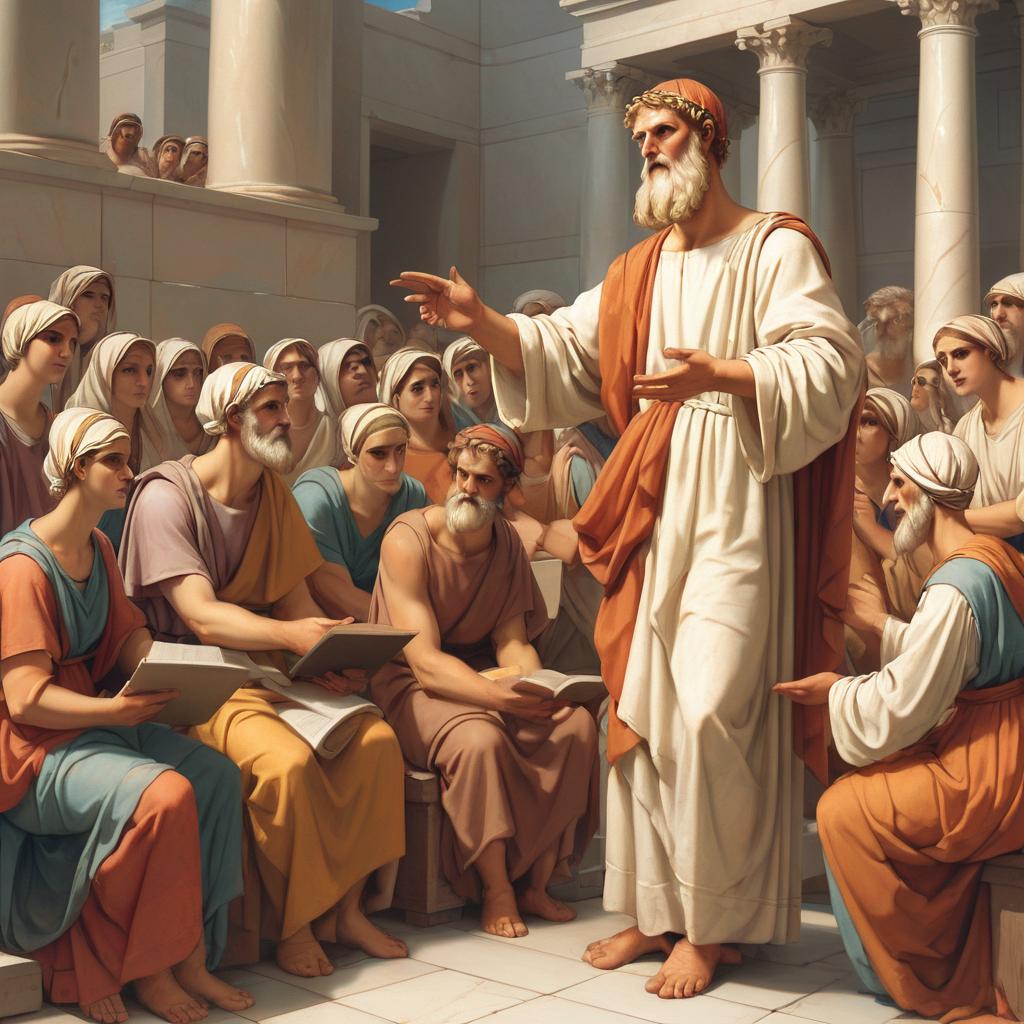
Imagine a world where the mystical and the rational dance together in harmony. Picture a man who walks the line between shaman and scholar, a sage whose teachings echo through the corridors of time. This man is Pythagoras, often known for his mathematical genius, but he was so much more than just numbers. He was a spiritual guide, a healer, and a philosopher who saw the universe as a grand symphony of harmony and balance.

Pythagoras lived around 570-495 BCE, in a time when the spiritual and the scientific were not separate but intertwined. He believed in the power of the human spirit to transcend the mundane and touch the divine. His philosophy was not just a dry, intellectual exercise; it was a way of life, a path to enlightenment.

One of Pythagoras’ most profound teachings is the concept of harmony. He saw the universe as a vast, interconnected web where everything vibrates with its own unique frequency. This idea, often referred to as the “Music of the Spheres,” suggests that the planets and stars move according to mathematical equations, producing a symphony that, while inaudible to the human ear, resonates throughout the cosmos. By aligning ourselves with this cosmic harmony, we can find balance and peace in our lives.

Think about it: our modern world is chaotic and noisy, filled with distractions that pull us away from our true selves. Pythagoras teaches us to listen to the subtle music of the universe. Through practices like meditation, deep listening, and mindful living, we can tune into this ancient wisdom. Just as a musician tunes their instrument, we can attune our minds and bodies to the harmonious frequencies of the cosmos.

Another cornerstone of Pythagorean thought is the belief in the immortality and transmigration of the soul. He taught that the soul is eternal and journeys through many lifetimes, learning and evolving with each experience. This belief can be incredibly empowering. It reminds us that our current struggles and challenges are just one chapter in a much larger story. By embracing this perspective, we can approach life with a sense of purpose and resilience, knowing that each moment is part of our soul’s grand adventure.

Pythagoras also emphasized the importance of living a life of purity and discipline. He believed that what we eat, how we treat others, and how we think and speak all contribute to our spiritual growth. This holistic approach to life is a powerful antidote to the fragmented, compartmentalized existence that many of us lead today. By adopting Pythagorean principles such as a plant-based diet, ethical living, and mental clarity, we can cultivate a life of harmony and balance.

Furthermore, Pythagoras’ insights into the power of numbers can offer us a unique lens through which to view our lives. He believed that numbers were the building blocks of reality, each carrying its own vibrational energy. By understanding the symbolism and significance of numbers, we can gain deeper insights into our life’s purpose and the hidden patterns that shape our experiences. For instance, the number four, representing stability and foundation, can remind us to ground ourselves amidst the turbulence of daily life.

In our quest for a meaningful existence, Pythagoras’ teachings encourage us to seek harmony in all things. Whether through the rhythms of nature, the cycles of the stars, or the patterns in our own lives, there is a profound order and beauty waiting to be discovered. By tuning into this cosmic symphony, we can transcend the noise of the modern world and find our place in the grand tapestry of the universe.

So, let us embrace the wisdom of Pythagoras, the shaman who invented philosophy. Let us listen to the music of the spheres, honor the journey of our souls, and live with purity and purpose. In doing so, we can uncover the hidden harmony that lies at the heart of existence and step into a life of true balance and peace.

The book is now available on Amazon

Search

Search Search

Subscribe & Download

Fill the blanks and receive your gift!

Loading...
Recent
  • Managing complexity: when logistics beats heroismJune 4, 2026 - 10:35 am
  • Would you cross the Rubicon, knowing you can only win—or...April 22, 2026 - 9:45 am
  • Does it ever feel like reality is working against you? It’s...March 30, 2026 - 3:40 pm
  • The True Potential of a Person, a Company, or a Team: A...March 12, 2026 - 11:41 am
  • From Sparta to the Market: The Invisible Grammar of Con...February 26, 2026 - 9:20 am
  • How to Solve Any Problem: Aristotle’s MethodFebruary 9, 2026 - 10:46 am
Popular
  • Areté: The Pursuit of Excellence in Modern LifeMay 15, 2024 - 4:08 pm
  • Kalokagatia: The Harmony of Beauty and GoodnessMay 15, 2024 - 4:11 pm
  • Paideia: The Foundation of Holistic EducationMay 16, 2024 - 10:03 am
  • Xenia: The Art of Hospitality and GenerosityMay 16, 2024 - 10:07 am
  • Mens Sana in Corpore Sano: The Harmony of Mind and BodyMay 16, 2024 - 10:28 am
  • Embracing the Mediterranean Way: A Guide to Health and ...May 16, 2024 - 10:32 am

Archives

  • June 2026
  • April 2026
  • March 2026
  • February 2026
  • January 2026
  • December 2025
  • November 2025
  • October 2025
  • September 2025
  • August 2025
  • June 2025
  • May 2025
  • April 2025
  • March 2025
  • February 2025
  • January 2025
  • December 2024
  • November 2024
  • October 2024
  • September 2024
  • August 2024
  • July 2024
  • June 2024
  • May 2024

Latest Articles

  • Managing complexity: when logistics beats heroismJune 4, 2026 - 10:35 am
  • Would you cross the Rubicon, knowing you can only win—or lose everything?April 22, 2026 - 9:45 am
  • Does it ever feel like reality is working against you? It’s not your imagination…March 30, 2026 - 3:40 pm
  • The True Potential of a Person, a Company, or a Team: A Lesson from AntiquityMarch 12, 2026 - 11:41 am
  • From Sparta to the Market: The Invisible Grammar of ConflictFebruary 26, 2026 - 9:20 am

Search the site

Search Search

Follow Me

  • facebook
  • youtube
  • instagram
  • linkedin
  • rss
  • mail

Contact

  • Mediterranean Way Project:
    much more than a diet!

  • mediterraneanwayproject@gmail.com

Follow us on Facebook

© Copyright 2026 - Mediterranean Way Project™ All rights reserved
  • Link to Facebook
  • Link to Instagram
  • Link to Youtube
  • Link to Rss this site
  • Link to Mail
Link to: Gnothi seauton (Know thyself): the source of all wisdom and knowledge Link to: Gnothi seauton (Know thyself): the source of all wisdom and knowledge Gnothi seauton (Know thyself): the source of all wisdom and knowledge Link to: Genoa and the dominion of the seas Link to: Genoa and the dominion of the seas Genoa and the dominion of the seas
Scroll to top Scroll to top Scroll to top
  • English
  • Français
  • Deutsch
  • Italiano
  • Română
  • Español