
Does it ever feel like reality is working against you? It’s not your imagination…
The ancients knew it (and sought the favor of the gods)
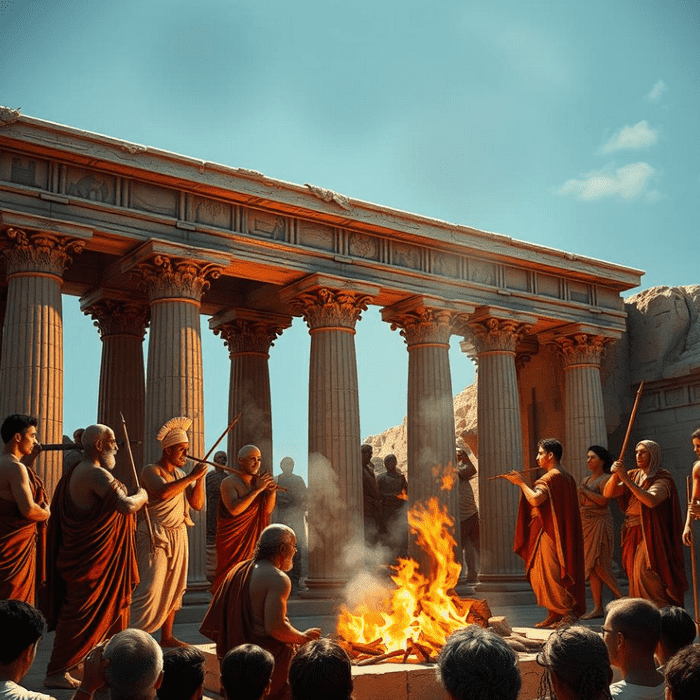
Have you ever experienced that kind of period in which the dominant feeling is not so much that things are going badly in an obvious way, but rather that reality itself seems to be working against you, as if every action, even the simplest one, had to pass through an invisible layer of resistance made of small setbacks, delays, and minor deviations which, over time, produce a very precise effect: you are doing the same things as always, with the same level of competence, and yet the results do not come?
These are not major failures — which, paradoxically, would be easier to understand — but rather that subtle sequence of micro-obstacles that, taken individually, could easily be dismissed as coincidence, but which, in their repetition, begin to take on the nature of a signal: something is not working in the direction you are moving.
The ancients, at least, had the advantage of narrative clarity: they spoke of the favor of the gods. It was not a moral issue, nor a reward for the virtuous; it was an empirical observation. When you were in their favor, things flowed; when you were not, even the simplest gesture became complicated. And, consistently with this view, they sought to obtain that favor through sacrifices — sometimes symbolic, sometimes decidedly less so — because “to sacrifice”, in its original meaning, meant precisely to make something sacred, that is, to create a connection with something higher, in an attempt to realign oneself with an invisible order. (On the subject of sacrifices, which are present in all ancient cultures, one could open an entirely separate discussion.)
Today we no longer speak of gods, yet we continue to describe the same phenomenon using different languages. We speak of being “in flow”, of “feeling that this is the right direction”, or — in a formulation that has become almost proverbial — of “following your bliss”. The expression is made famous by Joseph Campbell, a scholar of comparative mythology, who writes: “There’s something inside you that knows when you’re in the center… Follow your bliss.” Now, if we remove the motivational rhetoric with which this phrase has been overused, the point remains extremely concrete: there exists an internal feedback system that tells you when you are centered — and, above all, when you are not.
And here the discussion becomes interesting, because if there exists a state in which everything flows with a certain naturalness, then its opposite must also exist. And to describe it, there is no need to resort to spiritual metaphors: a more stripped-down reading is enough. When you pursue an objective with which a part of you — for whatever reason — does not truly agree, the system begins to sabotage itself. Not in a spectacular way, but in a precise one: a slightly mistimed decision, a less clear communication, an almost imperceptible hesitation. Small deviations which, when accumulated, produce exactly that effect which, from the outside, we call “reality working against you”.
At this point, what the ancients attributed to the absence of the favor of the gods takes on a much more operational meaning: it is not the world that is closing itself against you, it is your system that is no longer functioning in a coherent way. And the world, quite simply, reacts accordingly.
It is no coincidence that a similar idea emerges even in apparently distant fields. Eliyahu M. Goldratt, the creator of TOC (Theory of Constraints), shows how every system, no matter how complex, is limited by a point that conditions its entire functioning: as long as that point remains active, everything else becomes inefficient. If we translate this principle to the human being, it becomes almost obvious in its simplicity: the limitation is rarely external; it is that internal part which does not collaborate, which diverts energy, which introduces friction.
When that point dissolves — or, more precisely, when the system returns to coherence — something happens which, from the outside, appears as luck: decisions become faster, energy concentrates, relationships align, and suddenly what previously required enormous effort begins to move with a certain ease.
Perhaps this is precisely what, for millennia, we have tried to describe through different metaphors: gods, destiny, vocation, flow. The words change, but the phenomenon remains remarkably stable. When you are aligned, the world seems to open; when you are not, every door feels twice as heavy.
And so, perhaps, the right question is not whether the favor of the gods truly exists.
But whether, in this moment, you are moving in the right direction — or simply ignoring a signal that keeps repeating itself.
by Brunus


