
Fit for What? The True Purpose of Physical Training
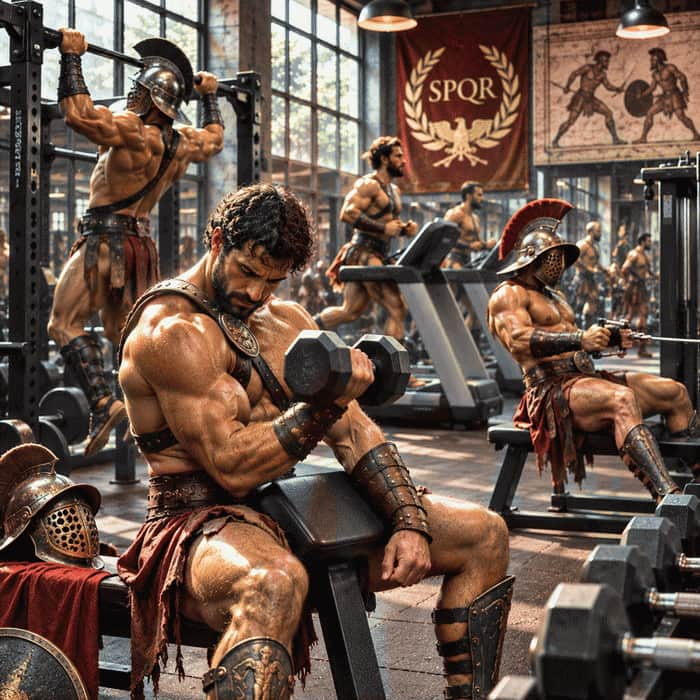
One of the things I find intriguing about the contemporary fitness world is that, despite the enormous amount of time, money, and energy that millions of people invest in trying to get “fit,” hardly anyone seems to ask a question that, from a purely semantic point of view, should precede any training program: fit for what?
The English word fitness, in fact, denotes, even before referring to a physical condition, a state of suitability—that is, the extent to which the characteristics of something or someone meet the requirements of a given function; talking about fitness without having defined the function in question is therefore rather like discussing the quality of a tool without knowing what it is supposed to be used for.
And yet, judging by the images with which the fitness industry bombards us daily, it would appear that the fundamental purpose of physical training is to acquire an appearance that suggests the ability to do things that, paradoxically, we are not particularly concerned about actually being able to do.
When the Body Was a Tool, Not an Image
A Roman gladiator, however much his physical appearance might have contributed to his popularity, did not train to parade on a podium, but to survive in the arena; similarly, a legionary had to be able to march dozens of kilometers carrying his equipment, contribute to the construction of a military camp, and still have enough energy left to face a possible battle.
This does not mean, of course, that the ancient Mediterranean world attached little importance to physical beauty—it would be enough to look at the legacy of Greek sculpture to convince ourselves otherwise—but rather that physical beauty was part of a much broader conception of human development, in which the efficiency of the body contributed to the quality and fullness of existence.
The Absurd Dichotomy Between Body and Intellect
Further complicating matters is the fact that, as in many other areas of our existence, we continue to pay the price of certain cultural legacies that the nineteenth-century mentality, in its various and often contradictory manifestations, helped consolidate: among these is the curious conviction that the development of intellectual faculties and that of physical abilities are not merely independent pursuits, but somehow mutually exclusive.
In our collective imagination, nourished by two centuries of literature and a century of cinema, two complementary stereotypes persist: on the one hand, the individual who is all muscle and no brain; on the other, the frail, pale intellectual, complete with the inevitable round spectacles and, preferably, afflicted with that form of tuberculosis which contributed so much to the appeal of the Romantic hero.
So much so that, even today, while we find it perfectly normal for an intelligent individual to be physically inefficient, we tend to regard it as almost a statistical anomaly that a formidable athlete might also be a sophisticated intellectual.
In classical Mediterranean culture, however, it was not the coexistence of these qualities that called for an explanation, but rather the failure to develop either of them.
Plato, according to Diogenes Laertius, practiced wrestling and is said to have competed in the Isthmian Games; Socrates, as Alcibiades tells us in the Symposium, had demonstrated, during the military campaigns in which he took part, a degree of physical endurance and an ability to withstand hardship that left his fellow soldiers astonished.
And even during the Renaissance, which, not coincidentally, represented a rediscovery of the ideals of classical civilization, we find in Leonardo da Vinci an individual who, besides being one of the most extraordinary geniuses in human history, possessed, according to Vasari’s account, such physical strength that he could bend a horseshoe with his bare hands.
The educational ideal of Greek paideia, like the Renaissance ideal of the uomo universale, consisted not in sacrificing certain dimensions of human existence in order to develop others, but in bringing each of them to its fullest expression.
The Lesson of Socrates
Particularly enlightening in this respect is an episode recounted by Xenophon in his Memorabilia (III, 12), in which Socrates, having observed the poor physical condition of a young man named Epigenes, reproaches him for his lack of physical training.
To the young man’s objection that he is not an athlete, Socrates responds by pointing out that there is virtually no human activity, including those of an intellectual nature, that cannot benefit from better physical condition, and concludes by remarking how shameful it is to reach old age, through sheer negligence, without ever having discovered the strength and beauty of which one’s own body might have been capable.
An observation that, twenty-four centuries later, has lost none of its validity and that, incidentally, would be particularly worth recalling to those who believe they have no need to exercise precisely because of the predominantly intellectual nature of their professional activities.
The Concept of Functional Reserve
If I were to define the objective of a physical training program inspired by the philosophy of the Mediterranean Way, I would identify it as the enhancement of what we might call functional reserve—the margin between the physical capabilities at our disposal and those ordinarily demanded of us by the circumstances of life.
If climbing four flights of stairs represents the limit of my abilities, every time I have to do so I will be forced to operate at the maximum of my resources; if, on the other hand, I am capable of climbing twenty, the same activity will require relatively little effort, leaving me with physical and mental energy to invest in other pursuits.
Which, incidentally, means that one of the objectives of physical training should be not so much to enable us to perform extraordinary feats of exertion, but to make ordinary what would otherwise constitute extraordinary exertion.
Strength, endurance, mobility, balance, coordination, and recovery capacity are therefore different dimensions of a physical training approach that, rather than pursuing the extreme optimization of a single parameter, should seek to broaden the range of our operational capabilities, also taking into account those unforeseen situations that life, with little regard for our training schedules, might require us to face.
Training to Live, Rather Than Living to Train
The point, obviously, is not to turn us all into gladiators, Olympic athletes, or special forces soldiers, but to recover a conception of the body as the instrument through which we exercise our freedom: every physical ability acquired or preserved ultimately represents an additional opportunity to interact with the world, just as every unnecessarily lost ability constitutes a limitation of our freedom of choice.
Moreover, just as it would be absurd to neglect the development of one’s intellectual faculties simply because one engages in a predominantly physical occupation, it should seem equally absurd to neglect the development of one’s physical abilities in the name of an intellectual vocation: in both cases, what we are doing is voluntarily relinquishing a part of our human potential.
And if, as the ancient Greeks hoped, this functional efficiency is accompanied by beauty, so much the better; provided that we do not make the mistake, so characteristic of our image-driven civilization, of confusing the representation of a quality with its actual possession.
The purpose of physical training is not to become better at training, but to become more capable of living.
by Brunus


