
• Link to Facebook
  • Link to Instagram
  • Link to Youtube
  • Link to Rss this site
  • Link to Mail
  • English English English en
  • Français Français French fr
  • Deutsch Deutsch German de
  • Italiano Italiano Italian it
  • Română Română Romanian ro
  • Español Español Spanish es
email: mediterraneanwayproject@gmail.com
Mediterranean Way Project
  • Home
  • About
    • The Mediterranean Way Project
    • The P.L.U.S.U.L.T.R.A. Codex™
    • Brunus Januensis
  • The Mediterranean Way To…
    • Nutrition & Healthy Food
    • Fitness & Wellness
    • Work & Business
    • Self Development & Spirituality
    • Family & Relationships
    • Art & Creativity
  • For Companies
    • Sales Course – Basic
    • Sales Course – Advanced
    • Communication Skills
    • Mastering Persuasive Presentations
    • Health and Wellness Programs
    • Stress Management and Work-Life Balance
    • Leadership Basic
    • Advanced Mediterranean Leadership Mastery
    • Mediterranean Coaching
  • For Individuals
    • The Secrets of the Mediterranean Way: much more than a diet! The Book
    • OnLine Programs
    • Training & Coaching
  • Articles & News
  • Contact
  • Click to open the search input field Click to open the search input field Search
  • Menu Menu

Pythagoras and the music of the spheres: the universe as a perfect symphony
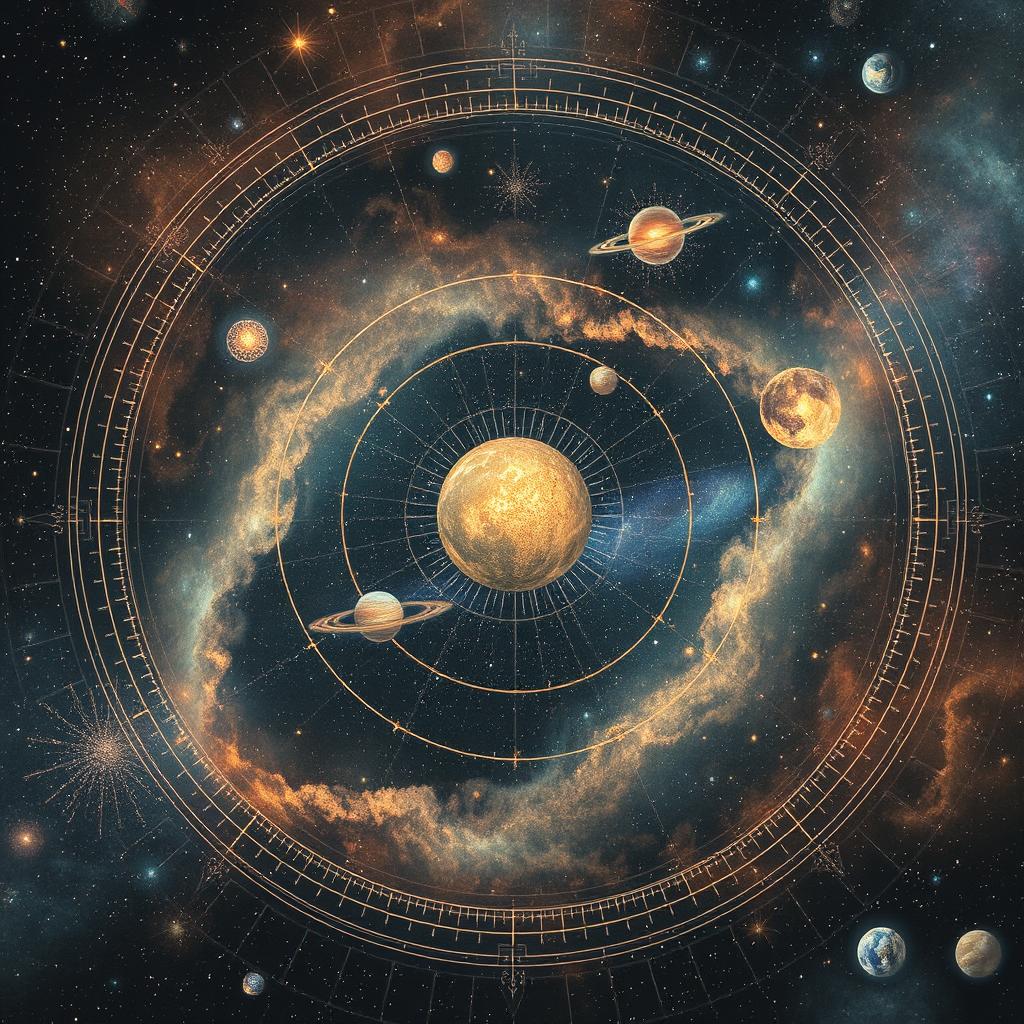
Imagine standing under a clear night sky, where the stars shine like scattered notes on a cosmic score. What if the universe were not just a collection of celestial bodies drifting through space, but an immense symphony in motion? This is the idea that Pythagoras and his followers left us: the concept of the music of the spheres, an invisible but fundamental universal harmony.

The universe is written in numbers and music

Pythagoras (6th century BCE) and his school saw numbers as the key to understanding reality. In their view, everything in existence follows precise mathematical principles, and music is one of the most tangible manifestations of this law. Pythagoras discovered that harmonic musical intervals correspond to simple numerical ratios: halving the length of a vibrating string produces a note an octave higher, while dividing it in proportions of 3:2 or 4:3 generates fifths and fourths.

If musical harmony follows mathematical rules, why not apply the same principle to the entire cosmos? Pythagoras hypothesized that the motion of the planets was also governed by numerical ratios, producing a perfect and constant music— a cosmic harmony that permeates all of creation, even if it remains imperceptible to our ears.

The hidden harmony of the cosmos

In ancient times, sound was considered more than just a vibration; it was the reflection of a higher order. The planets, moving in their orbits, were thought to generate sounds proportional to their speed and distance, creating a universal melody that, while inaudible to humans, influenced the soul and the destiny of mankind.

Plato expanded on this idea in The Republic, describing the world’s harmony as a principle that regulates justice and order. Later, in the 17th century, Kepler attempted to demonstrate the music of the spheres with his theory of elliptical planetary orbits, translating the proportions of planetary motion into numerical relationships.

Even today, science tells us that everything vibrates, from atoms to massive celestial bodies. In quantum physics, for example, string theory suggests that the fundamental nature of matter consists of microscopic vibrations. Perhaps Pythagoras was not so far from the truth after all.

What does it mean for us today?

The idea that the universe is governed by harmonic laws is not just a philosophical speculation; it is an invitation to seek harmony within ourselves and in our relationship with the world. If everything follows an invisible symphony, then our own lives can be experienced as a musical act:

  1. Listening to the rhythm of our existence
    Just as each planet has its own frequency, we too have an inner rhythm. Living in harmony means respecting it: alternating moments of activity and rest, following our natural timing without forcing it.

  2. Tuning in with our environment
    A musician does not play alone but adapts to other instruments to create harmony. The same applies to life: when we manage to resonate with those around us, the flow of existence becomes more natural and fulfilling.

  3. Avoiding inner dissonance
    Illness, stress, and discomfort often arise from a form of dissonance: when we make choices that do not align with our true nature, we create tension that sooner or later manifests itself. The solution? Restoring coherence between what we are, what we want, and what we do.

  4. Finding our note in the world’s orchestra
    If the universe is a great symphony, each of us is a unique and irreplaceable note. It is not about being the strongest or the fastest, but about playing our note with authenticity. A violin does not need to sound like a double bass, and vice versa. True harmony arises when each element expresses its essence in the purest way possible.

An invitation to “hear” harmony

Pythagoras leaves us with a powerful message: reality is not chaos but music. We may not be able to hear the music of the spheres, but we can perceive it in the beating of our hearts, in the waves of the sea, in the rhythms of the seasons, in the perfect proportions of a flower. The universe is constantly speaking to us—it is up to us to sharpen our hearing and learn to listen.

So next time you look up at the sky, remember that you are witnessing a grand symphony in motion. And don’t forget: you are part of it, too.

The book is now available on Amazon

Search

Search Search

Subscribe & Download

Fill the blanks and receive your gift!

Loading...
Recent
  • Managing complexity: when logistics beats heroismJune 4, 2026 - 10:35 am
  • Would you cross the Rubicon, knowing you can only win—or...April 22, 2026 - 9:45 am
  • Does it ever feel like reality is working against you? It’s...March 30, 2026 - 3:40 pm
  • The True Potential of a Person, a Company, or a Team: A...March 12, 2026 - 11:41 am
  • From Sparta to the Market: The Invisible Grammar of Con...February 26, 2026 - 9:20 am
  • How to Solve Any Problem: Aristotle’s MethodFebruary 9, 2026 - 10:46 am
Popular
  • Areté: The Pursuit of Excellence in Modern LifeMay 15, 2024 - 4:08 pm
  • Kalokagatia: The Harmony of Beauty and GoodnessMay 15, 2024 - 4:11 pm
  • Paideia: The Foundation of Holistic EducationMay 16, 2024 - 10:03 am
  • Xenia: The Art of Hospitality and GenerosityMay 16, 2024 - 10:07 am
  • Mens Sana in Corpore Sano: The Harmony of Mind and BodyMay 16, 2024 - 10:28 am
  • Embracing the Mediterranean Way: A Guide to Health and ...May 16, 2024 - 10:32 am

Archives

  • June 2026
  • April 2026
  • March 2026
  • February 2026
  • January 2026
  • December 2025
  • November 2025
  • October 2025
  • September 2025
  • August 2025
  • June 2025
  • May 2025
  • April 2025
  • March 2025
  • February 2025
  • January 2025
  • December 2024
  • November 2024
  • October 2024
  • September 2024
  • August 2024
  • July 2024
  • June 2024
  • May 2024

Latest Articles

  • Managing complexity: when logistics beats heroismJune 4, 2026 - 10:35 am
  • Would you cross the Rubicon, knowing you can only win—or lose everything?April 22, 2026 - 9:45 am
  • Does it ever feel like reality is working against you? It’s not your imagination…March 30, 2026 - 3:40 pm
  • The True Potential of a Person, a Company, or a Team: A Lesson from AntiquityMarch 12, 2026 - 11:41 am
  • From Sparta to the Market: The Invisible Grammar of ConflictFebruary 26, 2026 - 9:20 am

Search the site

Search Search

Follow Me

  • facebook
  • youtube
  • instagram
  • linkedin
  • rss
  • mail

Contact

  • Mediterranean Way Project:
    much more than a diet!

  • mediterraneanwayproject@gmail.com

Follow us on Facebook

© Copyright 2026 - Mediterranean Way Project™ All rights reserved
  • Link to Facebook
  • Link to Instagram
  • Link to Youtube
  • Link to Rss this site
  • Link to Mail
Link to: Hecate, Circe and the Cumaean Sibyl: three mysterious female figures who guide us beyond the limits of the known Link to: Hecate, Circe and the Cumaean Sibyl: three mysterious female figures who guide us beyond the limits of the known Hecate, Circe and the Cumaean Sibyl: three mysterious female figures who guide... Link to: Epicurus and the art of managing chaos and complexity: small variations, big results. Link to: Epicurus and the art of managing chaos and complexity: small variations, big results. Epicurus and the art of managing chaos and complexity: small variations, big...
Scroll to top Scroll to top Scroll to top
  • English
  • Français
  • Deutsch
  • Italiano
  • Română
  • Español