Nous: The ancient concept behind modern New Age
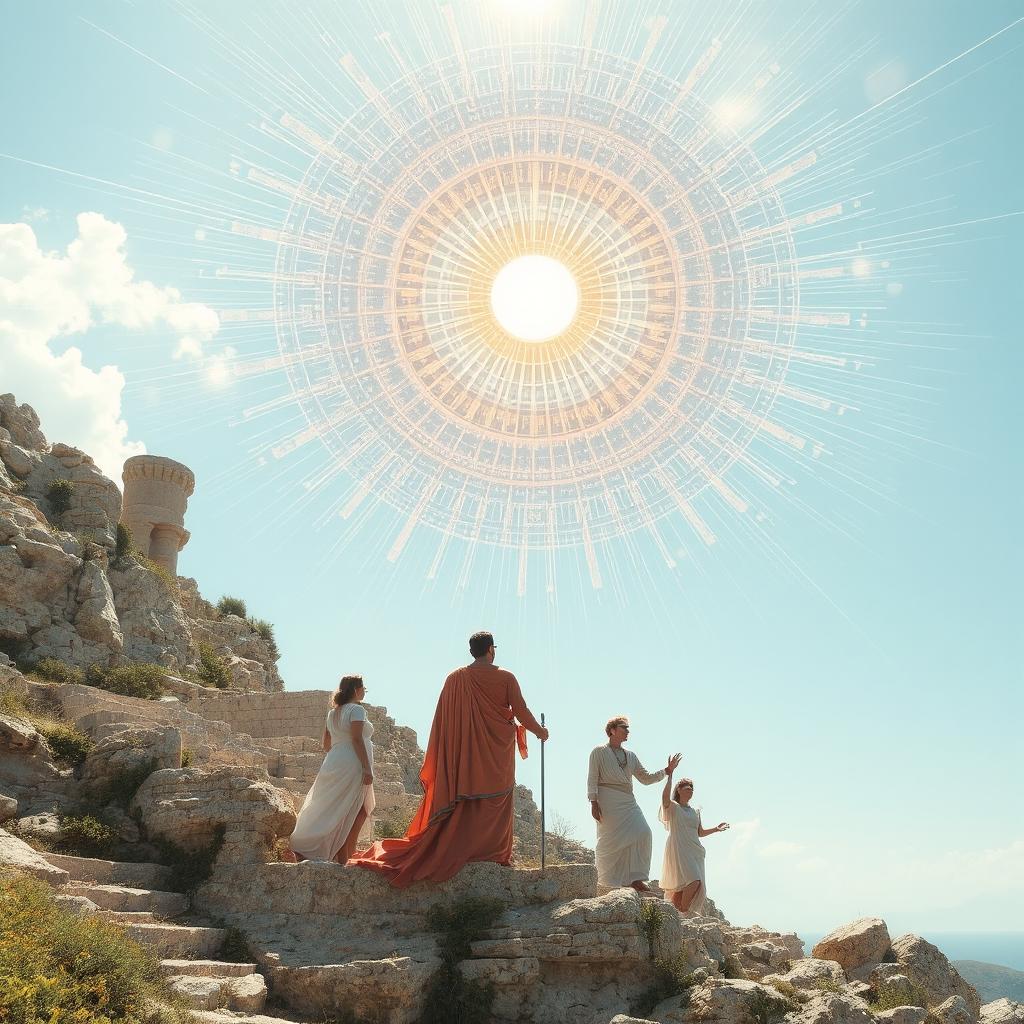
What if the ideas that fuel today’s New Age movements—mindfulness, flow, the higher self, and cosmic intelligence—weren’t modern at all? What if they had their roots in a 2,500-year-old concept from ancient Greece? That’s exactly the case with nous (νοῦς), a word that encapsulates ideas about the mind, reason, and even the divine. Let’s take a journey to discover how this ancient notion laid the groundwork for many of today’s most cherished spiritual practices.
What is Nous?
In ancient Greek philosophy, nous was more than just “mind” or “intellect.” It was the spark of divine reason, the principle that connects us to a higher order. Early Greek thinkers like Anaxagoras saw nous as a cosmic intelligence that brought order to the universe. For Plato and Aristotle, it was the faculty that allowed humans to understand eternal truths, bridging the gap between the material and the divine.
If this sounds a bit abstract, think of nous as the ancient equivalent of the universal mind or cosmic intelligence that many New Age thinkers describe today. It’s the rational, guiding principle that pervades all existence and resides within each of us.
The connection to Mindfulness
One of the core teachings of mindfulness is the ability to rise above distractions and focus on what truly matters. Ancient Greek philosophers understood this as a function of nous: the capacity to align with higher truths instead of getting lost in the noise of daily life. Plato, for example, argued that nous allows us to perceive the eternal Forms, the unchanging ideals behind the chaos of the material world.
In mindfulness practice, we seek clarity and balance by being present. Similarly, the Greeks saw cultivating nous as essential for achieving harmony, both within ourselves and with the cosmos.
Flow: the Nous in action
Modern psychology describes flow as a state of total immersion in an activity where time seems to disappear, and effort feels effortless. Aristotle’s concept of active nous resonates deeply with this idea. For Aristotle, nous wasn’t just a passive observer—it was the driving force behind our ability to engage with the world at the highest level, where intellect and intuition blend seamlessly.
Ancient Greeks believed that living a life of areté (excellence) meant using nous to fully realize our potential. Whether in art, philosophy, or sport, the state of nous in action bears a striking resemblance to what we now call flow.
The Higher Self and Nous
In many New Age teachings, the higher self represents our truest, most divine nature—a part of us that transcends ego and connects with universal wisdom. Ancient Greeks, too, believed in the idea of a higher aspect of the self. Plato described the soul’s journey as a return to the divine realm of truth and reason, led by nous.
For Aristotle, nous was the immortal part of the soul, a divine fragment that linked humans to the eternal. It’s easy to see how this evolved into the modern idea of a “higher self” guiding us toward our best lives.
Cosmic intelligence: Nous as the order of the Universe
New Age philosophies often describe the universe as an intelligent system—a grand design governed by a higher consciousness. This mirrors the ancient Greek view of nous as the principle that orders and animates the cosmos. Anaxagoras famously claimed that nous was the force behind the organization of the universe, setting everything in motion and maintaining harmony.
This idea still resonates today. When we talk about aligning ourselves with the universe or trusting in a higher intelligence, we echo the Greeks’ belief in the power of nous to guide and sustain all things.
Timeless wisdom for modern times
So why does nous still matter? Because it speaks to something timeless in us: the desire to connect with a greater order, to live with clarity, purpose, and creativity. Whether through mindfulness, flow, or exploring the higher self, the ancient Greeks’ insights into nous remind us that these pursuits are not new—they’re part of an enduring human quest.
As you meditate, journal, or lose yourself in creative work, consider this: you are tapping into the same force that inspired Greek philosophers to gaze at the stars and ponder the nature of existence. In every breath of mindfulness, every moment of flow, and every flash of insight, nous lives on.
Doesn’t that make your New Age practices feel a little more ancient—and infinitely more profound?


